Excavating any settlement invariably leads to surprises and the discovery of intriguing objects. Often, these finds are tools or everyday items, occasionally so corroded or fragmented that discerning their original function is challenging. This difficulty is compounded with older artifacts, which are increasingly estranged from our visual and cultural memory.
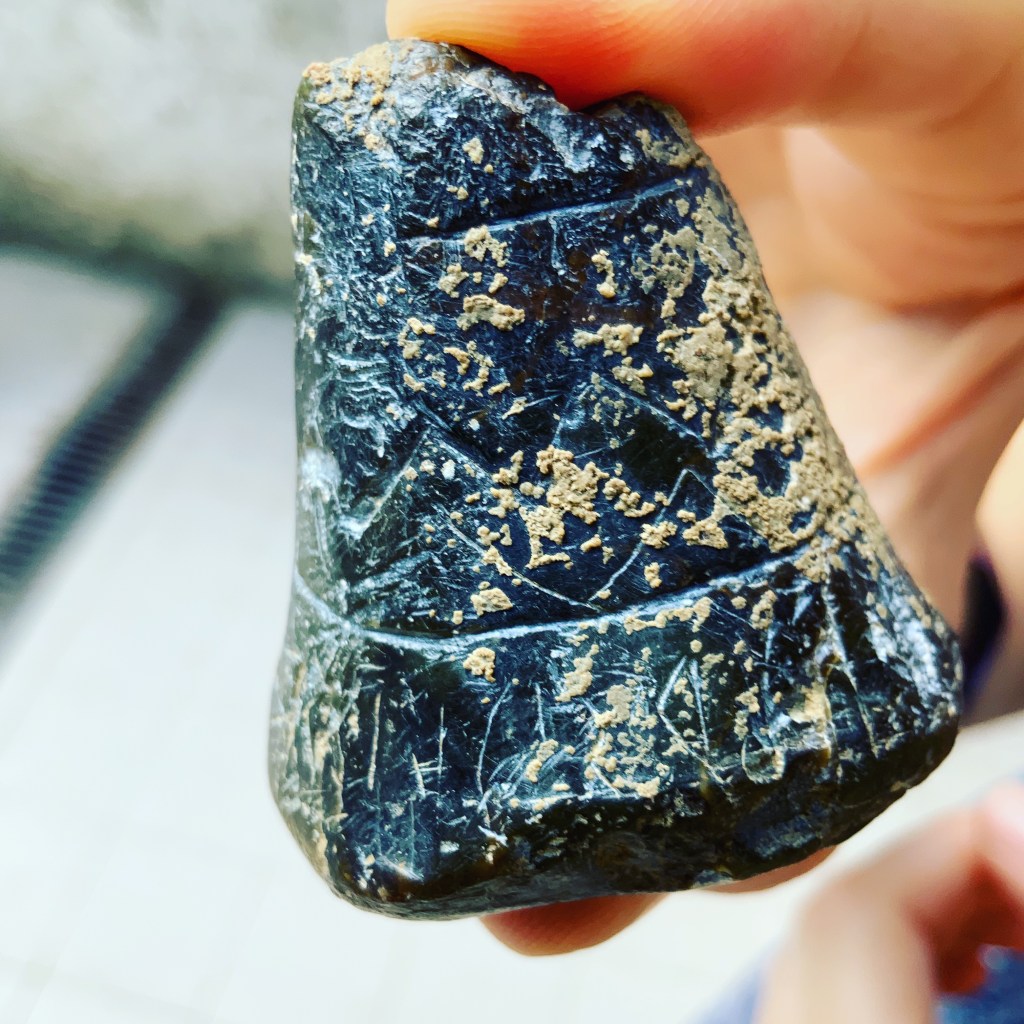
In 2019, during the archaeological excavations at Podere Cannicci, a trapezoidal object emerged from the soil. Initially identified as a loom weight, it bore a resemblance to numerous such weights recovered from Room III during that excavation season.
Subsequent laboratory analysis and cleaning unveiled surprising details. Contrary to initial assumptions, the object was composed of stone, not clay, and featured incised geometric decorations arranged in bands. The lowest band revealed an Etruscan inscription, translating to “I belong to Carcu, the son of Laris.” This artifact has undergone thorough study, and its function and historical context are expounded in a detailed essay in Studi Etruschi.
Contrary to its initial identification as a loom weight, the object was determined to be a steelyard weight, used for measuring specific quantities of particular foods. This discovery elucidates one of the functions of the Room in which it was found. Moreover, it provides insights into the identity and sacred connections of the late Etruscan community of Cannicci, highlighting the continuity between Etruscan and Roman traditions in this liminal region.
 Alessandro Sebastiani
Lascia un commento