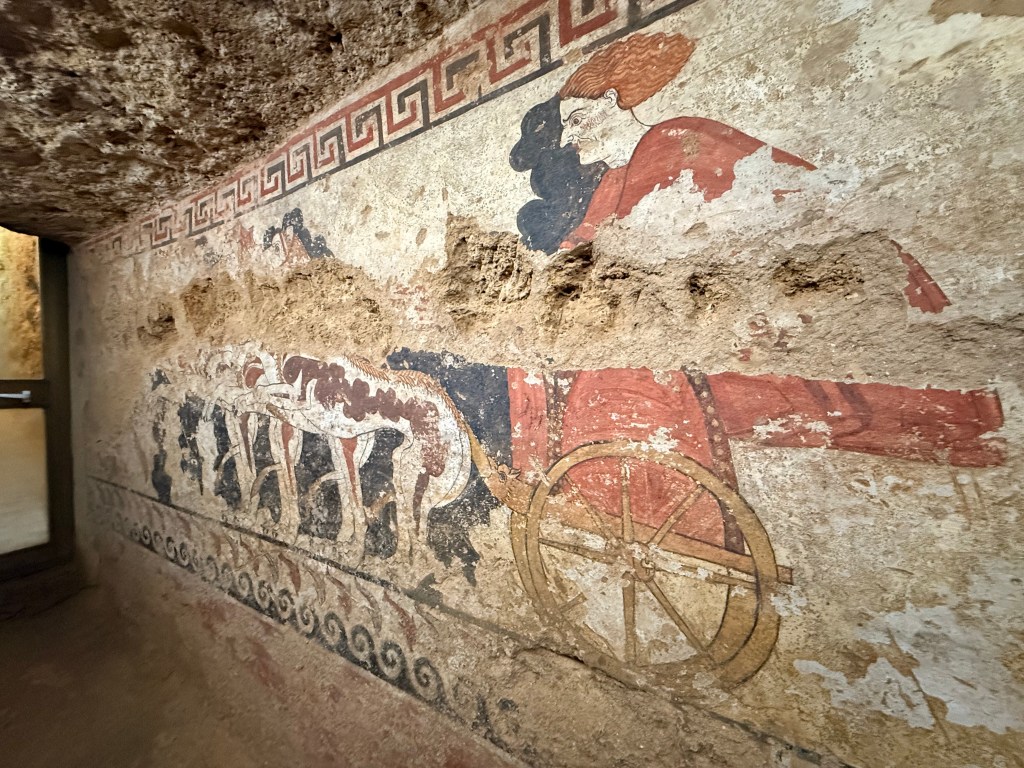
There are few sites where the Etruscan imagination of the afterlife compellingly evokes a sense of human experience like the Tomb of the Infernal Quadriga at Sarteano. Discovered just over ten years ago, this tomb retains a surprising amount of its painted decoration, a conjunction that will instantly pull you into the liminal space between life and death that its ancient pictorial artists imagined.
The entrance scene gets you right away. There, Charun, the terrifying psychopomp of the Etruscan underworld, drives his quadriga – his infernal chariot – into the underworld. Charun’s red hair and furious countenance are a mixture of menace and vigor, an embodiment of the inescapable force of fate. Just at the end of the chariot, we can discern the winged Vanth – gentler in spirit, yet resolute and inexorable – as she emerges from almost complete obscurity. Vanth’s figure is now partly eroded, likely by the pick of tomb robbers searching for treasure. The same pick that searched for treasure now bears witness to an unintentional passage of time and to the long unease this tomb has left behind.
Inside, the space opens into a chamber where two figures—perhaps father and son, or perhaps lovers—are shown reclining at a banquet. One is young, the other older; their hands meet in a quiet gesture that transcends generations and mortality. Around them coils a three-headed hydra, a guardian-demon rendered in dark, almost metallic tones that amplify its terrifying vitality. At the center lies an alabaster-like plaster sarcophagus, recovered in fragments and carefully reconstructed—a reminder of both loss and rediscovery.
As you stand before these walls, the complex weight of emotion felt before a tomb—wonder, fear, reverence, sadness—stirs inside you. And under it all, there is an odd kind of calm; death was not thought of by the Etruscans as an end, but simply a transition. The transition from the light to the shadow is something to be faced with courage, accompanied by demons, gods, and the collective memories of those gone before.
And then, as one steps back into the world of the living, the somber tones of the paintings seem to dissolve into the golden October light, warm, almost hesitant, yet radiant in its quiet insistence. It is a light that softens the darkness left behind, guiding the visitor toward new directions and emotions, luminous and tender in their awakening.
 Alessandro Sebastiani
Lascia un commento