Buffalo City Hall remains one of the most compelling architectural statements in the city, not simply because of its scale, but because of the extraordinary care with which every surface, proportion, and decorative program was conceived. Built between 1929 and 1931 and dedicated in 1932, the building is a 32-story Art Deco landmark designed by Dietel, Wade & Jones, and conceived not as a neutral administrative container but as a monumental expression of Buffalo’s civic identity, industrial energy, and historical ambition. The result is a structure in which stone, steel, glass, and ornament work together with unusual confidence.
What is especially striking is the building’s decorative coherence. The exterior and interior were designed around a dense symbolic language tied to Buffalo’s history, labor, shipping, engineering, and public life. The main entrance, for example, translates industrial forms into architectural ornament, while the lobby and corridors are enriched by murals and sculptural programs that narrate the city’s past and imagine its future. This is architecture understood not merely as construction, but as civic storytelling, and that ambition can still be felt in the careful recurrence of motifs and in the disciplined search for harmony across the entire building.
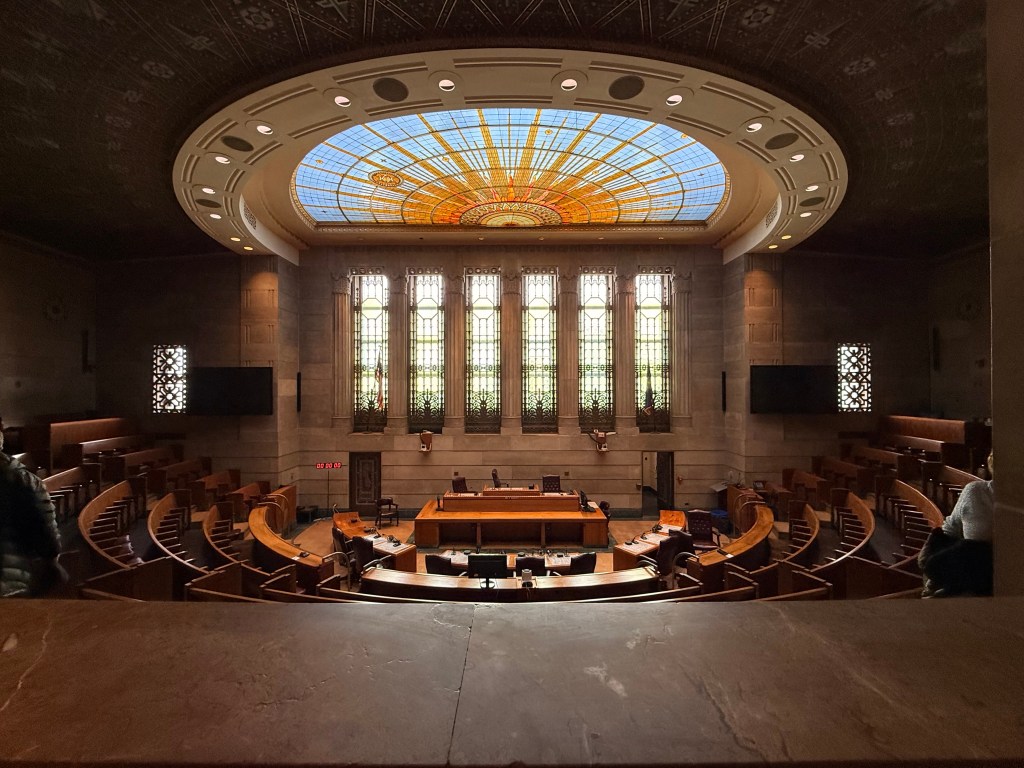
Few spaces, however, are as memorable as the Common Council Chamber. Its great stained glass ceiling is conceived as a radiant sunburst, combining Art Deco geometry with references the building’s designers associated with Indigenous visual traditions. The chamber’s lighting was planned so that the prismatic glass would diffuse light without casting harsh shadows, turning illumination itself into part of the architectural composition. Other accounts note that the ceiling can also be read as a celestial image, with the sun, moon, and planets rendered overhead. The effect is not only beautiful, but almost theatrical: a civic room transformed into a space of atmosphere, symbolism, and controlled visual drama.
At the same time, Buffalo City Hall preserves iconographic elements that can feel unsettling when seen through an Italian lens. In the Council Chamber, symbols of authority, including fasces, remain visible as part of the original decorative program. In the American context of the building’s early twentieth-century design, these belonged to a broader classical and civic vocabulary; yet for an observer shaped by the Italian historical experience, they inevitably carry a more troubling charge. That tension does not diminish the building’s fascination. On the contrary, it makes clear how architecture can preserve meanings across time while also acquiring new and uncomfortable ones.
And then there is the ascent upward. From the observation level, Buffalo unfolds in a way that clarifies the urban ambition behind the tower itself: the waterfront, the city fabric, and even the radial planning associated with Ellicott’s design become part of the experience. The view does not merely impress; it completes the building’s argument. Buffalo City Hall was meant to dominate, to symbolize, and to be seen. From above, that vision still leaves little room for indifference.
 Alessandro Sebastiani
Lascia un commento