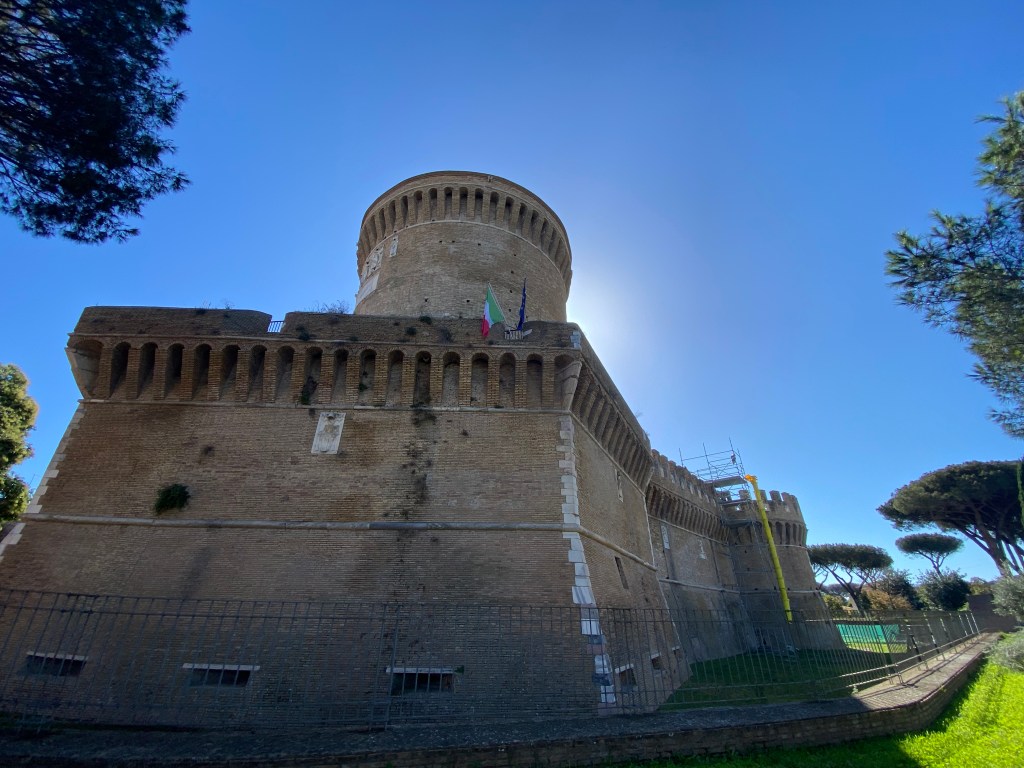
When most people think of Ostia Antica, they imagine bustling Roman streets, grand bath complexes, and lively markets. However, a fascinating chapter of Ostia’s history is often overlooked—the Rocca di Giulio II. This fortress towers over the site, providing a window into a much later period of the area’s evolution.
Built in the late 15th century during the papacy of Giulio II (Pope Julius II), the Rocca was constructed to protect the mouth of the Tiber River, a crucial gateway to Rome. This impressive structure served as a military outpost and a residence, designed to safeguard the region from external invaders and internal conflicts during a turbulent time in Italian history.
One of the most striking features of the Rocca is its cylindrical keep, surrounded by sturdy, defensive walls. The fortress became a symbol of papal authority in the area, asserting control over the strategic river access. With its angled bastions and moat, the design itself reflects the shift in military architecture, adapting to the increasing use of gunpowder in warfare.
A remarkable aspect of the Rocca di Giulio II is the extensive use of spolia, or recycled materials from the ancient Roman city of Ostia. Almost every wall of the Rocca contains fragments of ancient columns, capitals, and other architectural elements that were repurposed during the fortress’s construction. These reused Roman elements not only speak to the availability of building materials but also underscore the continuity of Ostia’s built environment across the centuries.
These ancient remnants give the Rocca a unique character, blending the grandeur of Rome’s imperial past with the functional, defensive architecture of the late Middle Ages. The fortress is a testament to how new eras continuously built upon the legacy of earlier ones, physically embedding Ostia’s Roman history into its medieval present.
For scholars and visitors, the Rocca di Giulio II is more than just a military stronghold—it’s a vivid reminder of how Ostia’s ancient cityscape was transformed and incorporated into the region’s medieval and Renaissance narrative. Exploring the fortress allows us to see Ostia as a relic of Rome’s empire and as a living, evolving space shaped by centuries of history beyond antiquity.
So, while the ancient ruins of Ostia Antica continue to captivate with their grandeur, the Rocca di Giulio II offers a different yet equally intriguing chapter—a medieval structure that reuses and reinterprets the past to build something new.
 Alessandro Sebastiani
Lascia un commento