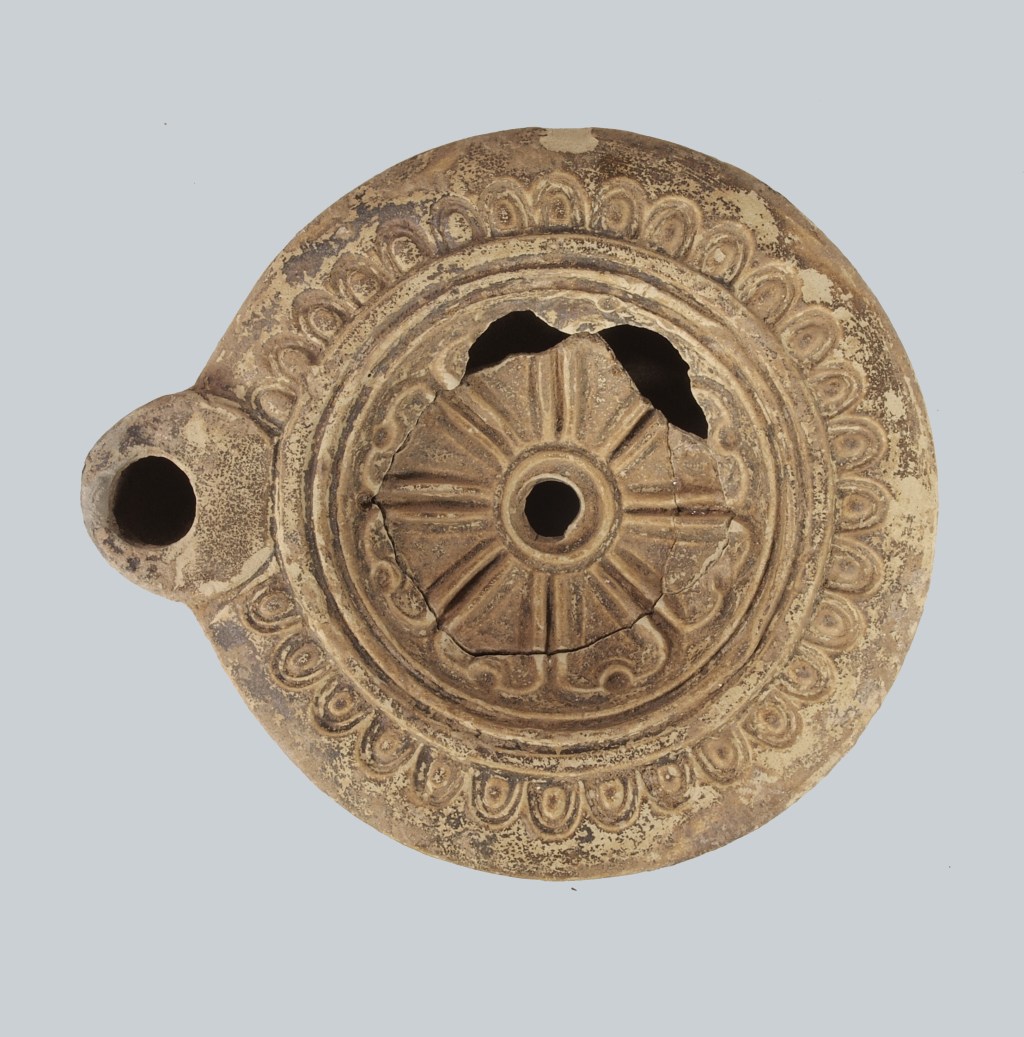
The sanctuary of Diana Umbronensis at Scoglietto, an ancient cult site dedicated to the Roman goddess, has yielded important finds that enrich our understanding of the ceremonial practices here between the Hellenistic period and Late Antiquity. Among the artifacts recovered is a Roman oil lamp, categorized as a Bailey O(iv), a type often associated with ritual contexts and dated to the end of the 2nd century CE. This lamp, used for illumination, bears witness to the nocturnal rites and offerings performed by worshipers and hints at the stratified symbolism tied to Diana’s cult.
Diana, venerated as the goddess of wild nature, hunting, and the moon, was also believed to protect the transitional spaces between human and natural realms. The sanctuary, nestled in a forested setting facing the mouth of the Ombrone River, provided an ideal locale for rituals emphasizing her liminal powers. The recovered lamp would have been essential in these rites, particularly during evening or dawn ceremonies, when light bridged the earthly and divine. The lamp’s design, with its decoration and efficient functionality, reflects the solemnity and focus on utility characteristic of votive items at such rural sanctuaries.
This lamp sheds light (both literally and metaphorically) on the broader religious landscape of the period. It likely played a role in rituals designed to connect devotees with Diana’s protective and fertile aspects, perhaps during communal gatherings where offerings of light, fire, and food were presented. The lamp’s discovery provides us with a tangible link to the past, helping to reconstruct the sensory environment of a sanctuary where devotees gathered to honor a goddess who stood as protector of nature, boundaries, and those who traversed them.
You can read more on the lamp here:
Brando M., 2015, La suppellettile da illuminazione, in A. Sebastiani, E. Chirico, M. Colombini and M. Cygielman (eds) Diana Umbronensis a Scoglietto. Santuario, territorio e cultura materiale (200 a.C. – 550 d.C.), Oxford, Archaeopress: 114-224
 Alessandro Sebastiani
Lascia un commento