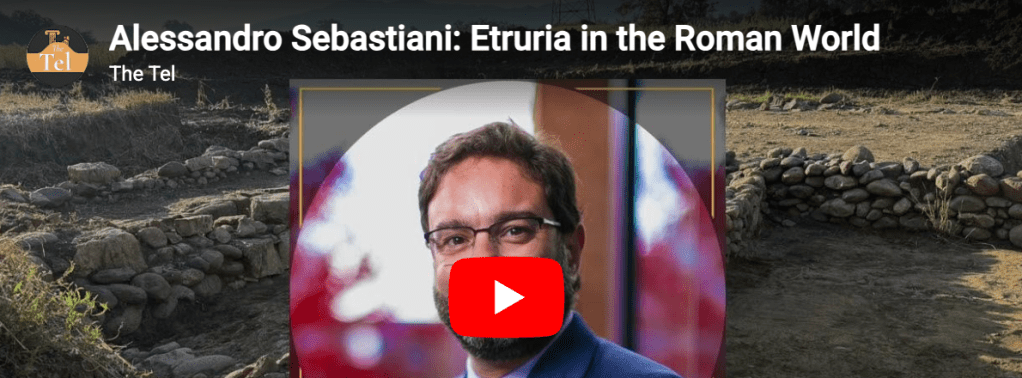
A few weeks ago, I had the pleasure of recording a podcast conversation on Etruria in the Roman world: the Roman conquest, the cultural transformations that followed, and the ways in which archaeology allows us to observe these processes not as abstract historical events, but as lived experiences within local communities.
The episode has now been published, and I am very happy to share it.
In the conversation, I discuss how sites such as Podere Cannicci can help us approach the complex transition between the late Etruscan and Roman Republican periods at a much finer scale. Large historical narratives often speak of conquest, integration, Romanization, or cultural change in broad terms. Archaeology, however, allows us to slow these processes down and examine how they unfolded in specific landscapes, settlements, households, and communities. It allows us to ask what changed, what remained, and how people negotiated new political and cultural realities in their daily lives.
The podcast also gave me the opportunity to reflect on my own path as an archaeologist. I began my career working primarily on medieval archaeology before gradually moving toward the classical world, and more specifically toward the late Etruscan and Roman Republican periods. That shift was not a rejection of one chronological field in favor of another. Rather, it made me increasingly aware of how important it is, in archaeology, to keep our chronological horizons wide.
After all, how can we truly understand a period of transition if we do not know what came before and what followed after? The transformations that affected Etruria under Roman expansion did not happen in isolation. They were part of longer trajectories of settlement, economy, identity, and social organization. In the same way, later historical developments often help us recognize patterns, continuities, or ruptures that might otherwise remain invisible.
For this reason, the podcast is not only about Etruria and Rome. It is also about the formation of an archaeological perspective: how research, fieldwork, and different sites shape the way we ask questions about the past. It is about moving across periods, landscapes, and methodologies in order to better understand moments of change.
I hope you will enjoy listening to the episode. It was a pleasure to take part in this conversation, and I am grateful for the opportunity to share some of the ideas, experiences, and questions that continue to guide my work.


Rispondi