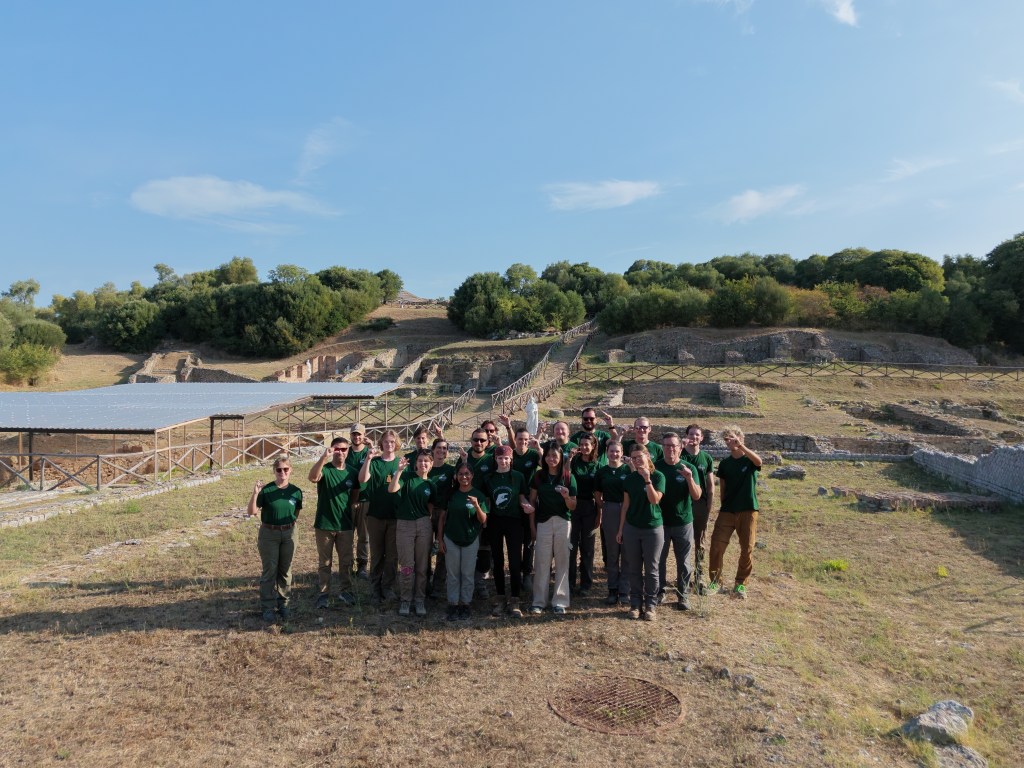
The first archaeological excavation season at the medieval cemetery surrounding the cathedral of Rusellae has recently come to an end. The four-week campaign produced significant new evidence while also opening several archaeological questions that will guide research at the site over the coming years.
The excavation area was located immediately north of the extensive sectors investigated by the Archaeological Museum of Grosseto between 1987 and 1991. The new campaign brought to light previously unknown burials, preliminarily dated to the later Lombard period, during the late seventh and eighth centuries CE. These discoveries are already providing important evidence for reconstructing the chronology, development, and internal organization of the cemetery.
Alongside the excavation, the project began the systematic mapping and digital documentation of the entire cemetery and the adjoining Hadrianic-period bath complex. High-resolution orthophotographs were produced, together with detailed three-dimensional models of the newly excavated graves and the surviving structures of the Roman baths. The team also mapped the network of service tunnels first identified by Antonio Minto during his excavations in the 1940s, integrating this important but still insufficiently understood feature into the broader digital reconstruction of the site.
The anthropology laboratory, directed by Professor Todd Fenton of Michigan State University, examined all the human skeletal remains recovered during the campaign. At the same time, the ceramic assemblages and small finds were preliminarily cataloged, inventoried, and prepared for further analysis. The integration of archaeological excavation, anthropological research, artifact study, and digital documentation represents a fundamental component of the project’s approach to the long-term history of Rusellae.
A second excavation campaign, scheduled for September, will allow the team to investigate several unresolved stratigraphic and chronological questions before the excavation areas are expanded during the 2027 season.
Despite the exceptionally high temperatures that affected all four weeks of fieldwork, the students and members of the research team continued their work with remarkable resilience, commitment, and professionalism.
We are deeply grateful to the Archaeological Park of Roselle for its generous hospitality and continued support, and to everyone who contributed to the success of this first season. The results obtained this summer mark only the beginning of a new phase of research into the transformation of Rusellae from a Roman city into one of the most important medieval religious and funerary landscapes of southern Tuscany.


Rispondi